

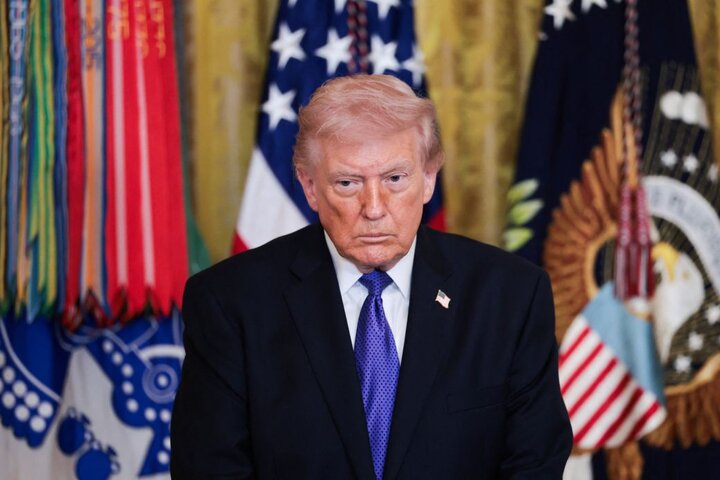
More than a month has passed since the start of a war launched by Donald Trump against Iran with aggressive rhetoric and ambitious objectives—a war that, according to him, was supposed to “change the regional equations,” “break Iran’s military power,” and, in some more explicit positions, even lead to a “change in behavior or political structure in Iran.”
Now, after one month of confrontation, what is visible on the ground shows a meaningful gap between the initial declared objectives and actual outcomes—a gap that not only points to Washington’s strategic failure, but also reveals signs of a gradual retreat in the language and demands coming from the White House.
1. Initial Objectives: From Deterrence to Changing the Equation
Trump began the war with a set of clearly defined goals. The first objective was to restore what he described as America’s lost deterrence against Iran—a deterrence he argued had weakened in recent years as Tehran expanded its regional influence.
The second objective was to seriously weaken Iran’s military infrastructure, particularly in the missile and drone sectors, which are widely considered the backbone of Iran’s deterrence capability.
The third, and perhaps most significant objective, was to force Iran to accept a new political-security order—whether through a fundamental behavioral shift or, at a deeper level, a change in governing structure.
Alongside these goals, securing energy flows and controlling vital regional waterways were also presented as key objectives. Before the war, Trump repeatedly stressed that the Strait of Hormuz would not be allowed to become an Iranian pressure tool, and that freedom of navigation through this critical route had to be guaranteed.
2. Tactical Operations by the Aggressors
At the tactical level, it cannot be denied that the United States and its allies inflicted certain blows. Some strikes on infrastructure, targeted assassinations, and efforts to disrupt Iran’s military networks produced short-term effects.
But the history of war clearly shows that tactical success does not necessarily translate into strategic victory.
What is evident today is that these blows have not led to the collapse of Iran’s military capability; rather, they appear to have accelerated its regeneration in a faster and more adaptive form. Iran’s missile and drone networks remain active and, in some cases, are operating with greater flexibility than before.
This means Trump’s key objective of disabling Iran’s deterrence instruments has, in practice, not been achieved.
3. Failure in Deterrence: An Equation That Has Not Changed
One of the most important indicators of success in such a war is a change in the opposing side’s behavior.
If Iran had retreated from its positions after one month of war—or at least reduced its level of activity—one could speak of restored American deterrence. But the reality is exactly the opposite.
Iran has not only maintained its positions but has also demonstrated the ability to manage both domestic and external fronts simultaneously. Targeted operations, preservation of defensive cohesion, and clear signaling to regional actors all indicate that the deterrence sought by Trump has not materialized.
In fact, it is the United States that now appears to be acting with greater caution in its calculations.
4. Retreat from Political Goals: From Regime Change to Crisis Containment
Perhaps the clearest sign of Trump’s strategic failure can be found in the shift in his tone and rhetoric.
A president who, in the early days of the war, spoke of “the end of Iran” and the necessity of “fundamental change” is now emphasizing “de-escalation” and “finding a solution” above all else.
This rhetorical shift reflects battlefield realities. The project of regime change—which may not have been officially declared, but was pursued in deeper layers of policymaking—has now effectively been removed from the agenda.
This means one of the principal strategic objectives has been abandoned without approaching any meaningful result.
5. The Strait of Hormuz: A Variable That Reversed the Equation
A key variable has meanwhile entered the equation—one that may not have been fully accounted for in Washington’s initial calculations: the Strait of Hormuz.
Before the war began, this vital passage was fully open and energy flows continued without major disruption. But with the onset of military aggression, Iran moved strategically to take control of this corridor and transform it into a strategic lever.
Now one of Trump’s principal goals has become “reopening” a strait that was already open before the war.
This contradiction sharply illustrates America’s strategic deadlock. Washington is trying to restore a condition that its own military action disrupted.
That means not only has no gain been achieved, but the situation has reached a more difficult point than before.
6. Domestic and Regional Pressure: A War That Expanded
At the same time, the war has not remained confined to one geography; it has gradually acquired regional dimensions.
American bases across the region, once considered relatively secure, have now become potential targets. This has significantly increased the costs of war for Washington and complicated its management.
Inside the United States, pressure on the Trump administration is also rising. Public opinion, Congress, and even parts of the political elite have serious doubts about continuing a war with no clear horizon.
These pressures have narrowed the White House’s room for maneuver and pushed it toward adjusting its objectives.
7. The Iranian People: A Decisive Factor in the Equation
Alongside all these factors, the role of the Iranian people cannot be overlooked.
Widespread public presence, preservation of social cohesion, and the continuation of ordinary life in cities have sent an important message to the other side: Iran will not experience internal collapse.
This societal presence, combined with military capability, has created a decisive equation that has altered the dynamics of war.
Contrary to the assumptions of the war’s planners, external pressure has not produced internal fracture; instead, it has reinforced solidarity.
This means one of the key assumptions underlying American strategy was fundamentally flawed.
8. Strategic Deadlock: A War Without a Victory Horizon
Taken together, these factors suggest that Trump has entered a strategic deadlock.
He can neither achieve his original objectives nor easily exit the war. Continuing the conflict increases costs, while retreat would amount to acknowledging failure.
Under such conditions, attempts to emphasize tactical gains resemble psychological messaging more than strategic reality.
Because ultimately, what matters is the achievement of overarching objectives—and so far those objectives have not only remained unmet, but in some cases have moved even further out of reach.
Conclusion
The experience of this war once again underscores an old reality: in war, strategy determines destiny, not tactics.
Blows may be exchanged on the battlefield, but if those blows do not alter the larger equation, they ultimately carry limited value.
Today, after more than one month, American deterrence has not been restored, Iran’s military capability has not been neutralized, the intended political transformation has not occurred, and even energy security has not returned to the desired condition.
By contrast, Iran has managed—through a combination of military power, strategic management, and public backing—to preserve its position and even strengthen it in some areas.
This means what has emerged from this war is less a sign of American victory than a reflection of the limits of American power when facing a resilient and multilayered actor—a reality that has compelled Trump to move away from his initial ambitions and seek a way out of a deadlock of his own making.
MNA
















Your Comment